Today is the day. I've been in love with Tina Turner's "We Don't Need Another Hero (Thunderdome)" for weeks now, so, to celebrate the end of my exam week, we are watching all three Mad Max films starting at 11 am. This will require discipline, perseverance, and, perhaps, a bucket. But we will succeed. Do we "live under the fear, until nothing else remains"? Perhaps. Maybe "all we want is life beyond the Thunderdome." If so, thankfully it only takes about 6 hours, given that each movie is around 90 minutes. However, we could also read the line as a metaphor for the dream of a life outside of the influence of the military-industrial complex, or beyond our post-9/11 surveillance culture. But that may drag our task out a lot longer. Who wants popcorn?
I gave a presentation about M.I.A.'s song "Paper Planes" today for Mina Yang's "Theorizing Popular Music" class. Students are giving presentations over the next few weeks where they need to use their new tools of analysis to pick apart a pop song. As the T.A., I volunteered to give an example presentation to help them out. I think it turned out really well, so I thought I'd post it here. Enjoy!
M.I.A. ends her hit “Paper Planes” with two brief but significant statements: “M.I.A. Third World democracy. I got more records than the KGB. So no funny business!” and “Some some some I murder, Some some I let go.” Catchy, right? Let’s see: “Third World democracy.” In the hook we get gunshots and cash registers. In the third verse, “Skulls and bones/Sticks and stones and weed and bongs.” We get images of an underground meritocracy driven by violence, drugs, and money. In the first verse, the narrator sells counterfeit Visas:
I’ll fly like paper, get high like planes If you catch me at the border I got Visas in my name If you come around here I’ll make ‘em all day I’ll get one done in a second if you wait
In the second verse, “every step [she] gets to [she’s] clocking that game”; a “bonafide hustler making [her] name.”
From the lyrics, “Paper Planes” could either be sad and grim realism or a hard glorification of the street, either of which would be familiar. Except we also get the novelty sound effects of gun shots and cash registers, set up by a quote from Wrecks-n-Effects’ “Rump Shaker,” which goes “All I wanna do is room a zoom a zoom zoom and a boom boom/Just shake your rump,” or, for M.I.A., “take your money.” Does she mean to tell us that stealing money at gunpoint is some kind of party? Later she says “we pack and deliver like UPS trucks.” So is it okay to be clever when boasting about shipping stolen goods and/or drugs? Is it really boasting? If this is grim realism, why is the song so much fun? Does that sense of fun add meaning to the grim realism, or confuse that meaning? Why is it charming and funny rather than chilling when she says “no funny business”? Especially preceding the chant “Some I murder, some I let go.” What codes and meanings are taking place here?
These are not easy questions to answer. I’ll begin with some context. Like the children in Slumdog Millionaire, which featured this song after it was a hit in the summer of 2008, M.I.A. grew up in a violent country. She is a refugee of Sri Lanka, which is governed by the majority Sinhalese Buddhists, though her family is of the oppressed minority Tamil Hindus. The civil war in Sri Lanka began in 1983, when the Tamil Tigers began a series of terrorists’ acts against the Sinhalese, including early examples of terrorist suicide bombings. In fact, these Tamil Tigers invented the “jacket” worn by suicide bombers, which we may be more familiar with from conflicts between Israelis and Palestinians. M.I.A.’s father is a Tamil Tiger, though she does not communicate with him and does not condone terrorist actions. Her mother left Sri Lanka with M.I.A. and her sister when M.I.A. was ten, and M.I.A. was raised and educated in London, England, with her mother and away from her father. Much of her music takes place in Third World communities like the one she grew up in where violence and terrorism are a continuous threat to everyday life.
Now, listen to “Paper Planes” with this in mind. Also listen to the beautiful sample that opens the piece, and the novelty sound effects in the chorus or hook. Then we’ll talk.
The music underneath most of “Paper Planes” comes from a passage in “Straight to Hell” by the Clash, a song from their 1982 album Combat Rock.
I believe the Clash’s song is about Third World people whose economies and cultures are displaced by war and imperialism, but it’s hard to say. I do know that Americans and Brits are the ones telling the victims that they are going Straight to Hell, like salt in an already painful wound. And it’s precisely this mentality that I believe our criminals in M.I.A.’s song are reacting against.
I believe this is the concept behind one of two major components to this song: both M.I.A.’s lyrics and the meaning attached to the Clash sample tell us that M.I.A.’s song is about the underprivileged getting there’s in a world that does not want them. Or, as critic Robert Christgau puts it, “Paper Planes” “imagine[s] and recreate[s] an unbowed international underclass that proves how smart it is just by stating its business, which includes taking your money.” All of which is interesting and meaningful, but may not actually capture what is truly magical and transcendent about “Paper Planes,” or M.I.A. as an artist. Our responses to beautiful art are rarely that rational.
Consider the gunshot and cash register sound effects in the refrain of this song. They do share a meaning with the lyrics, but they also share coding with the sound effects used in novelty songs. I’m thinking of “Leader of the Pack” by the Shangri-Las, with the motorcycle sounds that punctuate the hook “that when I fell for/the Leader of the Pack.” Or the seagulls in the refrain of their “Remember (Walking in the Sand).”
However, these sound effects are more dramatic than musical. Consider instead something like Sam Cooke’s “Chain Gang,” where the sounds of the hammers and grunts of a prison work crew contribute to the texture and rhythm of an otherwise conventional R&B song.
Though this is topical, more contemporary examples are less so. Missy Elliott inspired M.I.A. to rap, and she originally wanted to write her second album, Kala, which features “Paper Planes,” with Elliott’s former songwriting partner, Timbaland. (Unfortunately, M.I.A. was not allowed to stay in America at the time due to her father’s activities with the Tamil Tigers.) In Elliott’s “Work It,” sound effects stand in for words, though the content is more sexual than political. And other sound effects, like her backwards rhyming, are meaningful as music more than as text.
I believe “Paper Planes” also signifies with this kind of musical coding, so that, even though the lyrics depict a rather grim social crisis, the music contradicts that crisis with novelty sound effects, so that the greater meaning presented by the music and the lyrics together is more complex. Though the Clash lyric is similar to M.I.A’s lyric, I’m not sure we are expected to know the Clash sample independent of “Paper Planes.” And yet, if the music contradicts the lyrics, why do they seem to go together so well? Why is “more records than the KGB” funny rather than terrifying?
This is going way out of the parameters of this class, but I can’t help myself. I believe this is an example of Theodor Adorno’s theory of Negative Dialectics. In his writing concerning Negative Dialectics, Adorno was trying to make sense of why very dissonant, ugly music was so meaningful, and why consonant, beautiful music seemed to ring so false. He postulated that, after the tragedies of WWI and WWII, “beauty” could no longer be trusted; that beauty was easily corruptible, and could be used to manipulate people by provoking them to react with canned emotions. However, dissonant music, especially atonal music, did not produce canned emotions or reactions, and was therefore less corruptible, and more truthful.
Taken a step further, I believe that meaning in music in the late twentieth century is only possible when something expressive is cut with something inexpressive, or dissonant, or contradictory. So that something like “Paper Planes” would be less meaningful if it only expressed a grim reality—if it didn’t include novelty sounds and humor. Think about it: M.I.A.’s street hustlers aren’t selling counterfeit Visas, then crying about their lost childhoods. They’re boasting about their swagger. And this is truthful, too. It’s easy to set tales of whoa to sad music, and then to wallow in pity. But it’s not always entirely truthful. I’m glad M.I.A. writes about street life in “Third World democracies,” which in itself is funny and contradictory because these democracies are not about every citizen having a vote so much as every citizen fighting to get what’s there’s. I’m glad that reality has a voice. But I’m also glad M.I.A. is a musician as well as a storyteller, so that the messy, complex, contradictory, irrational, disturbing, and exhilarating reality of life can be expressed in all of its beauty. The world may be sad, but it’s also happy, often in the same instant. It’s something to think about. And in art, it’s something to treasure.
Over the last week of my hectic semester I found that I had three listening trends that I’m trying to make some sense of now that the semester is over. First, I can credit an interest in period instrument performances to Dr. Bruce Brown at USC; as I was studying for my final exam, I fell in love with the Beethoven and Mozart performances required as listening. Several of these recordings feature a pianoforte, which brings attention to each composers’ considerations of the range and texture of this new (at the time) instrument. What a difference! Subsequently, I borrowed the Trevor Pinnock collection of Mozart symphonies, and the John Eliot Gardiner collection of Mozart piano concertos, both on Archiv, from the library. Recommended.
Second, I can’t stop buying metal albums off of Decibel’s Best Metal of the Decade list. If you remember from a previous post, my metal phase started with Ian Christe’s book this summer, which led me to several albums I’ve come to like, but albums from the Decibel list that I’d never ever heard of are really stretching my personal aesthetic. I listen to a lot of metal out of interest, but now I’m listening because I’m sincerely addicted to it. Opeth’s Blackwater Park, which I bought a year or so ago, is now at the top of my personal playlist, despite serious reservations about Mikael Akerfeldt’s occasional crooning (I prefer it when he sounds like the cookie monster). Two things keep bringing me back:
1. Typically the songs will alternate between soft and loud passages, without referring to conventional song form. This is done so poorly so often that I’m enjoying how successfully this band can pull it off. The album comes across like a Romantic nineteenth-century symphony, as problematic as that can be for my personal aesthetic. The New Grove encyclopedia defines Romanticism as wild and unruly compared to classicism, which is a challenge for me because, as a Christgau-ian pop music scholar, I’m a classicist. But Opeth create rewarding peaks with these waves of action and emotion tempered by somber moments that still remain consistent within a larger metal aesthetic (which, I theorize, is essential for the genre). So rather than soak in each moment as a moment, I find the album gains power when you can hear each part within the larger composition, which happens as the album becomes more familiar.
2. Also, though I’m not a big fan of metal’s obsession with suspended chords and the lot, Akerfeldt finds some sweet notes within the harmony when he writes melodies, and the lead guitar parts pick up on them as well. I haven’t completed any kind of analysis, but to my ears it’s like when a jazz performer nails a flat 7th or another non-diatonic note within a chord—it’s unexpected and yet so perfect. And this happens on Blackwater Park quite often. Yummy.
Other than Blackwater Park, I’m listening to Cave In’s Jupiter, Isis’s Oceanic, and Mastodon’s Remission, and a few others, though I like these four the best so far.
The third listening trend is my addiction to Against Me!’s New Wave three years late. I finally picked it up at Rockaway records a couple weeks ago, and this week I’ve had it in steady rotation. For the record, 2007 is my favorite year for music. I get all tingly inside when I think about the first time I heard M.I.A.’s Kala, Arcade Fire’s Neon Bible, Lily Allen’s Alright, Still, and Rilo Kiley’s Under the Blacklight. I listened to Burial’s Untrue when I walked around Los Angeles at night during my first trip to California to interview with USC in January 2008. Crazy Ex-Girlfriend made me a huge Miranda Lambert fan. And 2007 was the year I taught my first music classes, so all of the music of this time is special to me. Anyway, that said, it took me a while to figure out New Wave.
In his Consumer Guide review, Robert Christgau writes that New Wave is produced by “Butch Vig (of Garbage, not Nirvana).” This doesn’t make a lot of sense after only a couple listens to the album; the compositions are terse and the production abrasive, which is unlike both Vig’s production for Garbage and Nirvana. But, again, with familiarity, the sound of each song opens up: you hear the layers of guitar overdubs, the backwards tape effect on “Borne on the FM Waves of the Heart,” and the background vocals on “Up the Cuts,” all of which are more typical of Garbage than Nirvana. And then you also hear the sublime moves outside of punk harmony in just about every song, and you hear the lyrics.
Ah, those lyrics! “Thrash Unreal” and “Borne on the FM Waves” have so much clear-eyed, unsentimental empathy, and so much love. And the calls for change in “New Wave” and “Up the Cuts” are so universal and full of hope. I just love it. In fact, I love it so much that I still haven’t absorbed the album past “Borne on the FM Waves”; after that song, I can’t help but go back to the beginning and listen to all six songs again.
Okay, that’s all for now. Below are links to Blackwater Park and New Wave over at Grooveshark. Thanks for reading!
I love procrastinating! While I'm supposed to be studying for exams today, I decided instead to make an album mix DVD for Steven of my favorite classical music. This was tricky because I don't follow any particular classical canon or critic, but rather rely on recommendations from a few sources, including Alex Ross and the Gramophone, and the hit or miss of borrowing and purchasing at random. As my friends know, I purchase and borrow popular music based on the criticism of Robert Christgau, to the point where its kind of a religious fanaticism. For classical, however, I've had a falling out with Alex Ross (nothing personal), and don't know where else to turn. So I just get whatever, listen to whatever, and try to find my way.
So, here are 22 recordings I adore. I am not an expert by any means, so these are not the "best" of anything except, perhaps, my personal collection. But I love them, and recommend them. Also note that there are very few adventurous recordings here--I'm not sure Steven would be into those. Merry Christmas!
C.P.E. Bach, Symphonies Nos. 1-4 (Andrew Manze) J.S. Bach, Bach Cantatas (Lorraine Hunt Lieberson) J.S. Bach, The Goldberg Variations (Glenn Gould/1955) Béla Bartók, The Piano Concertos (Anda/DG Originals) L.V. Beethoven, Symphony No. 9 "Choral" (Osmo Vänskä) David Behrman, On the Other Ocean/Figure in a Clearing (Lovely) Hector Berlioz, Symphonie Fantastique (John Eliot Gardiner/1991) Crystal Tears (Andreas Scholl) Gustav Mahler, Symphony No. 1 (Kubelik/DG Originals) Gustav Mahler, Symphony No. 6 (Claudio Abbado/2005) Olivier Messiaen, Quatuor pour la fin du temps (Walter Boeykens) W.A. Mozart, Clarinet Concerto/Clarinet Quintet (Martin Fröst) Arvo Pärt, Tabula Rasa (ECM) Prokofiev/Ravel, Piano Concertos (Argerich/DG Originals) Terry Riley, In C (Bang on a Can) Franz Schubert, Goethe Lieder (Fischer-Dieskau/DG Originals) Franz Schubert, String Quintet D.956 (Alban Berg Quartett) Robert Schumann, Dichterliebe (Wunderlich/DG Originals) Jean Sibelius, Symphonies Nos. 4-7 (Karajan/DG Originals) Song of Songs (Stile Antico) Igor Stravinsky, Pétrouchka/Le Sacre du printemps (Boulez/Sony) Toru Takemitsu, Chamber Works (Naxos)
Pitchfork published their list of the top 200 albums of the 2000s last week, and the net has a bunch of opinions about the matter, but none as interesting as this one: the lack of veteran performers. As you can see, this link is to a website dedicated to musicians who have performed for 25 or more years. Pitchfork gives up only 4 out of 200 to veterans, and surprisingly does not include either of Bob Dylan's masterpieces of the decade, Modern Times or Love and Theft, or Brian Wilson's Smile. Weird.
Everyone has a list of omissions, and mine includes: the Go-Betweens' The Friends of Rachel Worth and Oceans Apart, Mekons' OOOH! and Jon Langford's All the Fame of Lofty Deeds, Orchestre Baobab's Made in Dakar and Specialist in All Styles, Lou Reed's Ecstasy, Steely Dan's Two Against Nature, Tom Waits's Orphans, Madonna's Music, Tom Ze's Jogos de Armar, Maria Muldaur's Heart of Mine: The Love Songs of Bob Dylan, New York Dolls' One Day It Will Please Us to Remember Even This, Randy Newman's Harps and Angels, Orlando Cachaito Lopez's Cachaito, Marianne Faithfull's new Easy Come Easy Go, and Willie Nelson's new Willie and the Wheel.
Perhaps the most surprising offenses, beyond the above Dylan and Wilson omissions, are the absence of Youssou N'Dour, who released three near-perfect albums over the last 10 years (Nothing's in Vain, Egypt, and Rokku Mi Rokka), and the inclusion of Murray Street by Sonic Youth (their weakest in 25 years?) and the exclusion of two of their finest, NYC Ghosts and Flowers, and Rather Ripped. Of course, there's also the omission of Ornette Coleman's Pulitzer Prize winning Sound Grammar.
That said, Pitchfork's top 50 is pretty good, and though I'd replace most of them with my own favorites (like anyone), I enjoy contemplating their choices. Given their aesthetic, nothing in their top 20 seems ridiculous, which is kind of new for them. But really, people, you didn't hear a better album than Kid A this decade? I'm sorry to hear that. Let me recommend...
What a week! I made it through hours of grading, reading, and tutoring, so I've taken the last couple days off, more or less. I was pulling 10-12 hours days there for a while, so naturally I got a cold. This is happening more and more it seems. Anyway, sneezing and coughing aside, I've had a good couple days off. After my long haul of classes on Thursday, I watched a couple episodes of Battlestar Gallactica on DVD (I'm up to season 3), then the NBC Parks and Recreation, Office, and Community trifecta.
Am I the only one who loves these shows? Sure, everyone loves the Office, but I need to stand up for Parks and Recreation, and Community. I didn't like Parks and Recreation at first either, but the last episode of the first season pulled me in, and now I'm hooked. Yes, I expect Amy Poehler to be funnier too, but she's up to something with this character: she plays an ambitious woman with a huge heart who doesn't know herself or how the world works, and she ends up looking foolish again and again because she just can't conceive of a world that is inherently hurtful. She believes in perseverance and a fair meritocracy; that if she continues to build this park with good will in her heart, she will one day be president. Rather than laugh at her optimism, though, Poehler's character gets you to believe in a just society and a better tomorrow because to believe in them is essential to living, that we need to believe in these things to stay sane and happy; to remain pure at heart in a maelstrom of modernity. Also, it's still kind of funny. We laugh at these characters make asses of themselves, because at our best--at our most earnest--we make asses of ourselves as well. And we're better people for it. Like Christgau says, we all need a little corn in our lives. It helps you shake some of that cynicism out of your head. Poehler's character does that.
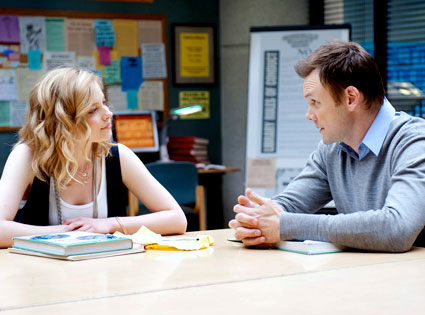
As for Community, well, what can I say? I love college (obviously), and this show sums up that strange emotional and temporal space that is college and the college campus. Bake sales and candlelight vigils for victims of government oppression? Check. Dead Poets Society professor who climbs trees and makes his students stand on their desks to feel liberated? Check. Lonely, socially awkward students looking to redefine themselves within a new social environment and failing miserably? Check. All of these are played for laughs, and yet, like Parks and Recreation, its a heartfelt show: we're not laughing at these characters, we're laughing with them. I also think the dialogue is sharp, and Joel McHale, here and on The Soup, is a treasure.
My Friday was also wonderful: Kit made us soup for dinner, which was great for my cold, and her baby Logan sat in his jumper for the first time. We watched him learn to use his legs to jump for about 20 minutes. It was so beautiful. I can't imagine what it's like for Logan right now, learning so much so fast. Then we sat down to watch Dollhouse, which aired its first bad episode. Good premise, but a bad script led to some bad acting. I guess you can't win all the time.
I also discovered Lala for myself. Lala is basically the best music store on the internet. The MP3s are reasonably priced, and you can listen to entire albums at CD quality before you purchase them. You can also buy "web albums" which are very cheap, but you can only listen to them streaming from the website; you cannot download them. But, you can listen to them from any computer anywhere. And even better, there is a program that matches the music on your hard drive to music on Lala, and let's you listen to that music streaming from their website on any computer. Did you catch that? You can stream your entire collection from Lala for free anywhere! Anything they don't own can be uploaded for free as well. It's really amazing, and very forward thinking. They also have a sale going on now for albums listed in Pitchfork's Top 200 albums of the 2000s. A bunch of them are only $2-3, and many are as low as $6. Brilliant. Here's a sample from Lala: [update: Lala closed. Below is a link to Grooveshark.]
I love lists. Even lists as strange as Pitchfork’s Top 100 Albums of the 1980s. Like everyone else I know, Pitchfork’s aesthetic agenda rubs me the wrong way. But I find that their rewriting of the '70s, '80s and '90s rock canons does offer readers a good context for their otherwise absurd and contrarian opinions and recommendations; better than any of their reviews, that’s for sure. However, I have to add that I’m not convinced there’s much truth, meaning or even entertainment value in some of the choices that create Pitchfork’s critical context, which is a shame. Isn’t that why we're in this business? So I thought I’d be an ass and put together my own alternative Top 40 Albums of the 1980s NOT listed in Pitchfork's list, in which I offer albums that I believe are far more reliable and meaningful choices than many of the ones compiled by Pitchfork.
I tried for 100, then 50, but 40 hit it just about right. Of course, I would include many of the albums in Pitchfork’s list; who wouldn’t? Who doesn’t love Thriller? Or Trust? Daydream Nation? Sign o’ the Times? So, take some of their list, maybe take some of mine, and you’ll get a pretty good take on the 1980s. As noted above, I can’t recommend some of the Pitchfork choices, but I recommend each of my selections below without reservation. And don’t just take my word for it: all of my choices are cribbed from lists by Spin Magazine, Robert Christgau, Pazz & Jop and various other similar critical institutions on the web.
And now, the rules: As with Pitchfork, I only consider classical and jazz albums with some kind of pop caché, and I include no single-artist compilations, though, for the record, I love compilations. Pitchfork includes Fela Kuti in their ‘70s list, so I figure Afro-pop is fair game. I was going to list my favorites alphabetically (it’s easier for shopping), but listing them in order of preference is really fun to write, and I find, fun to read. So, enjoy! Comments are encouraged.
1. X, Wild Gift (1981) 2. Marshall Crenshaw, Field Day (1983) 3. Bruce Springsteen, Born in the U.S.A. (1984) 4. Robert Cray, Strong Persuader (1986) 5. Franco & Rochereau, Omona Wapi (1983) 6. Lucinda Williams, Lucinda Williams (1988) 7. Marshall Crenshaw, Marshall Crenshaw (1982) 8. James Blood Ulmer, Odyssey (1983) 9. DeBarge, In a Special Way (1983) 10. Bruce Springsteen, Tunnel of Love (1987)
11. Los Lobos, How Will the Wolf Survive? (1984) 12. Lou Reed, The Blue Mask (1982) 13. The Indestructible Beat of Soweto (1986) 14. George Clinton, Computer Games (1982) 15. New Order, Brotherhood (1986) 16. The Blasters, Non Fiction (1983) 17. John Lennon & Yoko Ono, Double Fantasy (1980) 18. Professor Longhair, Crawfish Fiesta (1980) 19. Cyndi Lauper, She’s So Unusual (1983) 20. Lou Reed, Legendary Hearts (1983)
21. Flipper, Album—Generic Flipper (1982) 22. Lou Reed, New Sensations (1984) 23. Ornette Coleman, Of Human Feelings (1982) 24. Sonny Sharrock, Guitar (1986) 25. Richard & Linda Thompson, Shoot Out the Lights (1982) 26. Laurie Anderson, United States Live (1984) 27. The Blasters, Hard Line (1985) 28. Remmy Ongala, Songs for the Poor Man (1989) 29. Chic, Real People (1980) 30. Go-Betweens, Tallulah (1987)
31. Papa Wemba, L’Esclave (1988) 32. Ornette Coleman, Virgin Beauty (1988) 33. Alberta Hunter, Amtrak Blues (1980) 34. Neil Young, Freedom (1989) 35. King Sunny Ade, Aura (1984) 36. Aretha Franklin, Who’s Zoomin’ Who? (1985) 37. Hüsker Dü, Candy Apple Grey (1986) 38. Psychedelic Furs, Talk Talk Talk (1981) 39. Donald Fagen, The Nightfly (1982) 40. Angry Samoans, Back from Samoa (1982)




 Posts
Posts

